Gold vs Diamonds vs Precious Gemstones: A Value Comparison
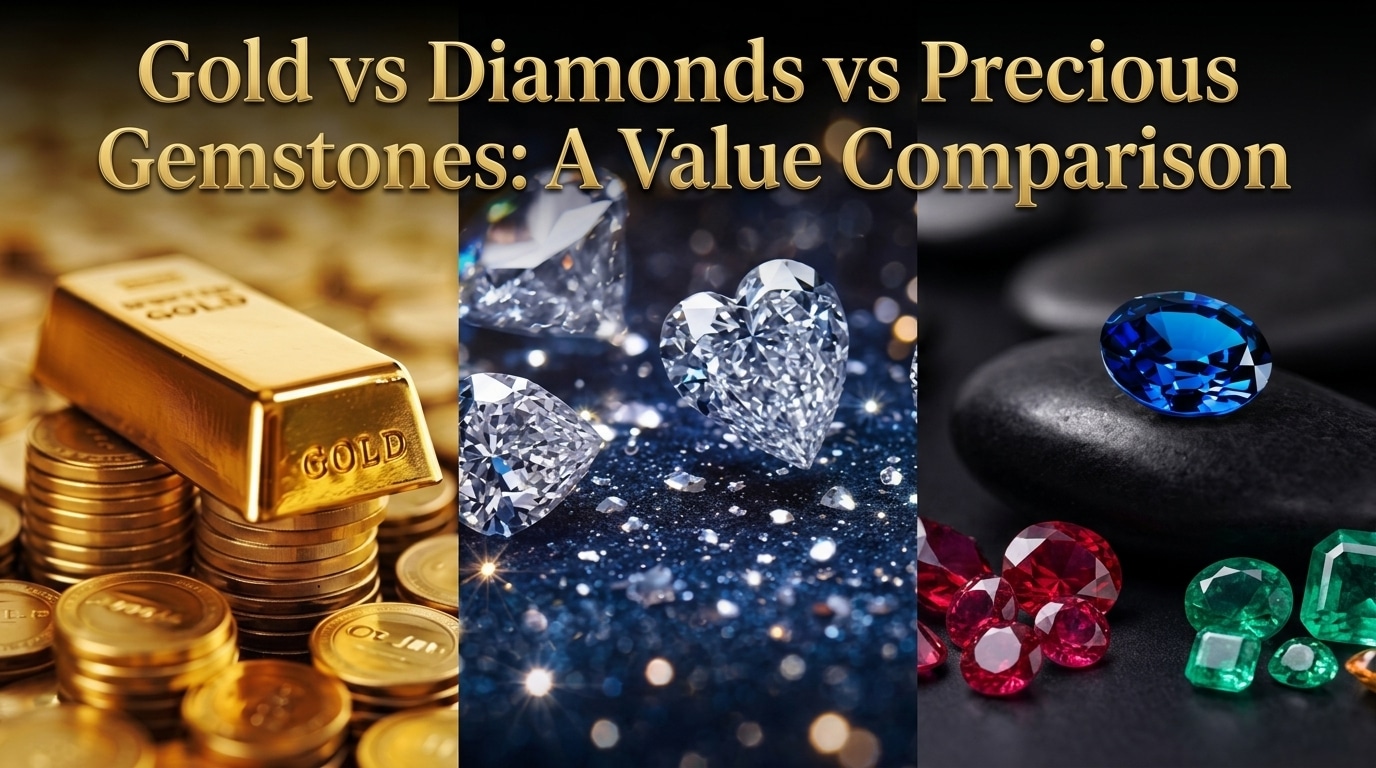
Compare gold vs diamonds vs precious gemstones to understand how purity, carat weight, quality, rarity and market demand affect their value.
Gold vs Diamonds vs Precious Gemstones: A Value Comparison
Gold, diamonds and precious gemstones have long been valued for their beauty, rarity and financial significance. From gold jewellery and investment bars to diamond rings and coloured gemstones, each offers unique characteristics that influence its market value.
However, determining which is worth the most requires more than comparing size or appearance. Gold is primarily valued according to purity and weight, while diamonds and coloured gemstones are assessed based on quality, rarity, treatments and market demand.
Understanding these differences can help jewellery owners make informed decisions when purchasing, evaluating or selling precious items.
Gold: How Purity and Weight Determine Value
Gold is a precious metal widely used in jewellery and investment products. Its value is influenced by international gold prices, currency exchange rates and the purity of the metal.
Gold purity is measured in karats. Pure gold is represented by 24K, while lower-karat gold contains a greater proportion of other metals.
| Gold Purity | Approximate Gold Content | Common Applications |
| 24K | 99.9% | Investment bars and coins |
| 22K | 91.6% | Traditional gold jewellery |
| 18K | 75% | Fine jewellery and gemstone settings |
| 14K | 58.5% | Everyday jewellery |
| 9K | 37.5% | Jewellery with lower gold content |
Higher-purity gold generally has a higher underlying metal value per gram, assuming comparable market rates.
For example, a 10-gram piece of 22K gold contains approximately 9.17 grams of pure gold, whereas a 10-gram piece of 18K gold contains 7.5 grams.
When selling gold jewellery, buyers typically consider verified purity, net gold weight and the applicable buying rate. Stones, clasps and other non-gold components may require separate assessment.
Diamonds: Quality Beyond Carat Weight
Diamonds are evaluated using four principal characteristics known as the Four Cs: carat, colour, clarity and cut. Each contributes to the stone’s overall quality and market desirability.
| Factor | Meaning | Influence on Value |
| Carat | The diamond’s weight | Larger stones may command higher prices |
| Colour | Colourlessness or fancy colour characteristics | Desirable and rare colours may increase value |
| Clarity | Internal inclusions and surface blemishes | Higher clarity grades can improve desirability |
| Cut | Proportions, symmetry and finishing | Influences brilliance and light performance |
A diamond’s value depends on the combination of these characteristics rather than its size alone. Two diamonds with identical carat weights can have significantly different prices because of differences in colour, clarity and cut.
The distinction between natural and laboratory-grown diamonds is also important. Although both can have similar physical and optical properties, their market prices and resale values can differ substantially.
Exceptional natural diamonds, particularly rare fancy-coloured stones, may command premium prices. However, the resale value of an individual diamond also depends on its documentation, condition and the availability of interested buyers.
Precious Gemstones: Colour, Rarity and Quality
Precious gemstones are valued according to their type, colour, clarity, transparency, size, treatment history and, where established, geographic origin.
Rubies, sapphires and emeralds are among the most recognised coloured gemstones, but their prices can vary considerably even within the same category.
| Gemstone | Important Quality Factors | Characteristics That May Increase Value |
| Ruby | Colour, clarity and treatments | Desirable red colour and exceptional rarity |
| Sapphire | Colour, transparency and treatments | Attractive colour and high overall quality |
| Emerald | Colour, clarity and transparency | Rich green colour and desirable characteristics |
A high-quality ruby may be more valuable than a sapphire of comparable size, but an exceptional sapphire or emerald can also command a higher price than a lower-quality ruby.
Treatments are another important consideration. Some gemstones undergo heating, filling or other processes to improve their appearance. The type and extent of treatment can influence market value, making professional identification useful when evaluating a stone.
Comparing Gold, Diamonds and Gemstones
Although all three categories can be valuable, their valuation methods and resale markets differ.
| Comparison | Gold | Diamonds | Precious Gemstones |
| Main valuation factors | Purity, weight and market rate | Four Cs and market demand | Type, quality, rarity and treatments |
| Pricing reference | Applicable gold market rate | Comparable stones and quality | Specialist assessment and comparable stones |
| Testing | Purity verification and weighing | Identification and grading | Gemological identification |
| Price transparency | Generally more transparent | Depends on stone quality | Can vary significantly |
| Resale considerations | Verified metal content | Quality and buyer demand | Rarity and specialist demand |
Gold generally has a more transparent pricing basis because its underlying metal value can be estimated from purity, weight and the applicable rate.
Diamonds and coloured gemstones require more individualised assessment. Their value cannot be reliably determined from weight or appearance alone.
Which Has the Highest Value?
There is no universal answer because the comparison depends on the items involved and the basis of valuation.
Among common gold purities, 24K gold generally has the highest underlying gold value per gram. However, exceptional natural diamonds and rare, high-quality gemstones can command substantially higher prices than ordinary stones or particular gold items.
For example, a rare natural pink diamond may be worth far more than a gold ring of similar weight. Likewise, a fine ruby or sapphire may achieve a premium price because of its exceptional quality and rarity.
On the other hand, ordinary gemstone jewellery does not automatically have a higher resale value than gold jewellery.
The original retail price is also not a reliable indicator of resale value. Jewellery prices may include design, craftsmanship, branding and retail costs that may not be recovered when selling.
How to Assess Value Before Selling
Understanding the valuation process can help jewellery owners make better-informed decisions.
For gold, confirm the purity and net weight, then ask which buying rate and calculation method are being applied.
For diamonds, consider obtaining a recognised grading report where appropriate. The report can provide information about quality, although it does not guarantee a particular selling price.
For coloured gemstones, professional identification can help establish the stone type, treatments and relevant quality characteristics.
It is also useful to keep existing certificates, purchase records and other supporting documents. When selling jewellery containing both precious metals and gemstones, ask whether the components are assessed separately and how the final offer is calculated.
Comparing offers may also help, particularly for rare gemstones, branded jewellery or high-quality diamonds that require specialist buyers.
Conclusion
Gold, diamonds and precious gemstones each have distinct characteristics that influence their value. Gold is primarily assessed through purity, weight and market prices, while diamonds and coloured gemstones depend on quality, rarity, treatments and demand.
Gold generally offers a more straightforward valuation process, but exceptional diamonds and gemstones can achieve remarkable prices. The most valuable item ultimately depends on its verified characteristics and the conditions of the relevant market.
If you are considering selling gold jewellery, diamonds or precious gemstones, a professional assessment can help you understand their characteristics and potential resale value.
Explore Cash Gold’s services to learn more about the valuables we evaluate.