How Diamonds and Gems are Valued: The 4Cs Explained
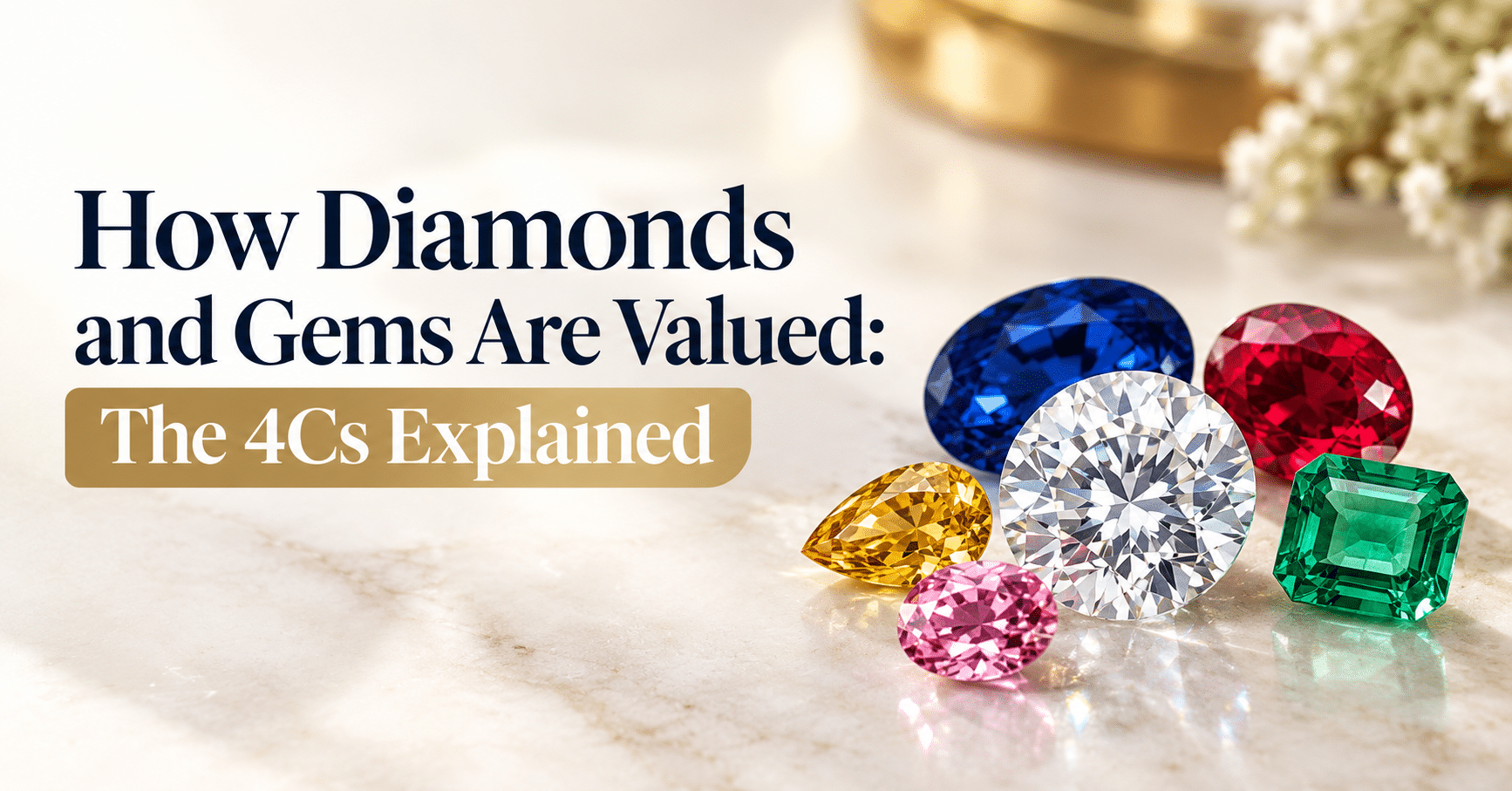
Learn how diamonds and gems are valued using the 4Cs, gemstone quality, rarity and treatments, and what to know before selling diamond and gemstone jewellery in Sri Lanka
How Diamonds and Gems are Valued: The 4Cs Explained
Diamonds and gemstones can look beautiful and similar in appearance but have very different market values. Their worth depends on several factors, including quality, rarity, weight, condition and market demand. Understanding these factors can help you make informed decisions when buying or selling valuable jewellery.
For diamonds, the internationally recognised 4Cs—Cut, Colour, Clarity and Carat weight—provide a standard way to assess quality. Other gemstones, such as sapphires, rubies and emeralds, are evaluated using additional characteristics specific to each stone.
Understanding the 4Cs of Diamond Valuation
The 4Cs are essential when determining a diamond’s quality and potential market value.
1. Cut
Cut describes how well a diamond has been shaped and polished, rather than its shape, such as round, oval or pear. A well-cut diamond reflects light effectively, creating brightness, sparkle and brilliance. A poorly cut diamond may appear dull, even if it has good colour and clarity.
Diamond cut grades commonly range from Excellent to Poor, depending on the grading system. A high-quality cut can significantly improve a diamond’s visual appeal and influence its market value.
2. Colour
White diamonds are generally graded on a scale from D to Z.
- D to F: Colourless diamonds, which are rare and often highly valued.
- G to J: Near-colourless diamonds with minimal visible tint.
- K to Z: Diamonds with increasingly noticeable yellow or brown tints.
Fancy-coloured diamonds, including blue, pink and yellow varieties, are assessed differently. Their value depends on factors such as colour intensity, rarity, quality and market demand.
3. Clarity
Clarity refers to internal characteristics called inclusions and external marks known as blemishes. These features can affect a diamond’s appearance and, depending on their size, position and visibility, its value.
The main clarity grades include:
- FL and IF: Flawless and Internally Flawless.
- VVS1 and VVS2: Very, Very Slightly Included.
- VS1 and VS2: Very Slightly Included.
- SI1 and SI2: Slightly Included.
- I1 to I3: Included, with imperfections that may be visible to the unaided eye.
A diamond does not necessarily need to be flawless to be attractive or valuable. Some stones with minor inclusions can still have excellent visual appeal.
4. Carat Weight
Carat measures a diamond’s weight, not its physical dimensions. One carat equals 0.2 grams.
Larger diamonds are generally rarer than smaller diamonds of comparable quality, so their prices can increase significantly with weight. For example, a two-carat diamond may cost considerably more than twice the price of a one-carat diamond with similar characteristics.
It is important to distinguish carat, which measures gemstone weight, from karat, which indicates gold purity.
How Are Other Gemstones Valued?
Although the 4Cs are particularly important for diamonds, other precious and semi-precious gemstones require a broader assessment. Their value depends on the type of gemstone and the characteristics that make it desirable.
1. Colour and Colour Quality
Colour is one of the most important factors when valuing coloured gemstones.
For example, sapphires are often valued for their attractive blue colour, while rubies are prized for their red hues. Emeralds are commonly assessed for their green colour and overall appearance.
The intensity, consistency and attractiveness of a gemstone’s colour can influence its value. However, the ideal colour varies according to the gemstone type.
2. Clarity and Transparency
Gemstones naturally vary in clarity. Some contain visible inclusions, while others appear relatively clear.
The effect of inclusions on value depends on the gemstone. Emeralds commonly contain natural inclusions, which do not automatically make them undesirable. In other stones, visible imperfections may significantly reduce value.
Transparency, brilliance and the way a stone interacts with light can also influence its appeal.
3. Cut, Shape and Craftsmanship
A gemstone’s cut affects its appearance, light reflection and overall attractiveness. A well-cut stone can display its colour and brilliance effectively, while a poorly cut stone may look less appealing.
The shape of the stone, the quality of the polishing and the suitability of the cut for the gemstone can all influence its marketability.
4. Carat Weight and Rarity
Larger gemstones of excellent quality can be particularly rare. However, gemstone prices do not increase according to weight alone.
A smaller, high-quality ruby or sapphire may be worth more than a larger stone with less desirable colour, clarity or origin-related characteristics.
The gemstone variety, natural rarity and current demand must all be considered when estimating value.
Natural, Treated and Synthetic Gemstones
Gemstones may be natural, treated or laboratory-grown. These categories can have different market values.
Natural gemstones form through geological processes. Some are treated to improve their colour or clarity, using methods such as heat treatment or fracture filling. Such treatments can affect value and should be disclosed during a professional assessment.
Laboratory-grown gemstones have similar or, in many cases, essentially the same chemical and physical properties as their natural counterparts, but they are created in controlled environments. They generally have different market values from comparable natural stones.
A gem’s identification, treatment status and any available laboratory report can help a professional determine its characteristics and estimate its market value.
The Importance of Certification
A gemstone certificate or grading report from a reputable gemological laboratory can provide useful information about a stone’s identity and characteristics.
For diamonds, recognised laboratories such as the Gemological Institute of America (GIA) and the International Gemological Institute (IGI) issue grading reports. Other laboratories specialise in gemstone identification and reporting.
Documentation can help diamond buyers and gem buyers assess a stone more confidently. However, a grading report is not necessarily a guarantee of resale price. The final offer also depends on market conditions, the buyer’s requirements and the stone’s condition.
Retail Price vs Resale Value
The original retail price of diamond or gemstone jewellery is not the same as its resale value. The retail price may include the jewellery design, manufacturing costs, branding, shop expenses and profit margins.
When selling jewellery, the value may depend on the gemstone’s quality, authenticity, demand, condition and resale potential. The gold or other precious metal used in the setting may also have a separate value.
This is why the amount offered for previously purchased jewellery is often lower than its original retail price. Understanding this difference helps sellers set realistic expectations before requesting a valuation.
Tips Before Selling Diamonds and Gemstones
If you are considering selling diamond or gemstone jewellery, these practical steps can help:
- Find any certificates or grading reports. These documents can help establish the gemstone’s identity and quality.
- Keep the original receipt or invoice. Although it does not determine the current market value, it can provide useful background information.
- Seek a professional assessment. A qualified professional can examine the gemstone and identify the factors affecting its value.
- Ask how the valuation is calculated. Understand which characteristics, market conditions and quality factors influence the offer.
- Assess the setting separately. Gold jewellery may have additional value based on its purity and weight.
- Understand treatments and origin claims. Ask whether the stone has been identified as natural, laboratory-grown or treated, where relevant.
Choosing experienced gold buyers, diamond buyers and gem buyers can help you understand the different components of your jewellery’s value before deciding whether to sell.
Final Thoughts
Diamonds and gemstones are valued based on their quality, rarity, individual characteristics and market demand. While the 4Cs provide a useful framework for assessing diamonds, coloured gemstones such as sapphires, rubies and emeralds require additional consideration of their colour, clarity, transparency, treatments and type.
Whether you own a diamond ring, a sapphire pendant, ruby jewellery or other precious stones, understanding these factors can help you make more informed decisions when buying or selling gemstones.
Before selling your diamond or gemstone jewellery, consider getting a professional assessment to understand its quality and potential resale value. Reputable diamond buyers and gem buyers evaluate the characteristics of each stone to determine its market worth, helping you make an informed decision before selling.